September 01 2026
When Too Many Lots Become Urgent
A data-driven approach to priority management in semiconductor manufacturing
Claude Yugma, Adrien Wartelle, Stéphane Dauzère-Pérès, Quentin Christ and Renaud Roussel
Priority management plays an important role in semiconductor manufacturing, where complex production routes, highly specialised equipment and tight capacity constraints make reliable scheduling essential. Engineering lots, prototypes, customer-critical orders and lots with strict deadlines may need to move through production faster than standard lots.
However, priority remains effective only when it is used selectively. When too many wafer lots are classified as urgent, high-priority lots begin competing with one another. Their acceleration decreases, while standard production may experience additional waiting time.
Research conducted in the context of SC4EU examines how historical production data can be used to quantify this effect and support more informed priority-management decisions in semiconductor manufacturing.
Learning from real production decisions
Traditional queueing models often assume that the highest-priority eligible lot is selected first. In a real semiconductor wafer fab, dispatching decisions are considerably more complex. Machine qualifications, recipe availability, setup requirements, equipment constraints and production efficiency all influence which lot is processed next.
The research therefore applies a data-driven approach based on historical production decisions. At each recorded operation start, the model analyses the composition of the production queue and identifies the priority class of the selected lot.
This makes it possible to estimate the effective priority delivered by the manufacturing system, taking into account not only formal priority rules but also scheduling tools, equipment constraints and actual operating practices.
Analysing more than 2.3 million production records
The study analysed 2,307,392 production-step records involving 21,546 wafer lots from the photolithography workcentre of a 300 mm wafer fab in France.
Five priority classes were considered: Low, Standard, Medium, Hot and Critical. Hot and Critical lots represented an average of 7.3% of the observed production volume, with weekly values ranging from 4.81% to 14.7%.
Several modelling approaches were evaluated, including multinomial models, a neural network and probabilistic score-based models. A compact five-score model reproduced the observed acceleration of the five priority classes with a mean absolute relative error below 5%. An analytical fluid model also approximated the simulated queueing behaviour with an error below 1.5% under the highly congested conditions observed in the workcentre.
What happens when more lots become urgent?
The models were then used to examine how changes in the proportion of high-priority lots affect production performance. The results show a clear relationship: as the combined proportion of Hot and Critical lots increases, the acceleration achieved through priority gradually decreases.
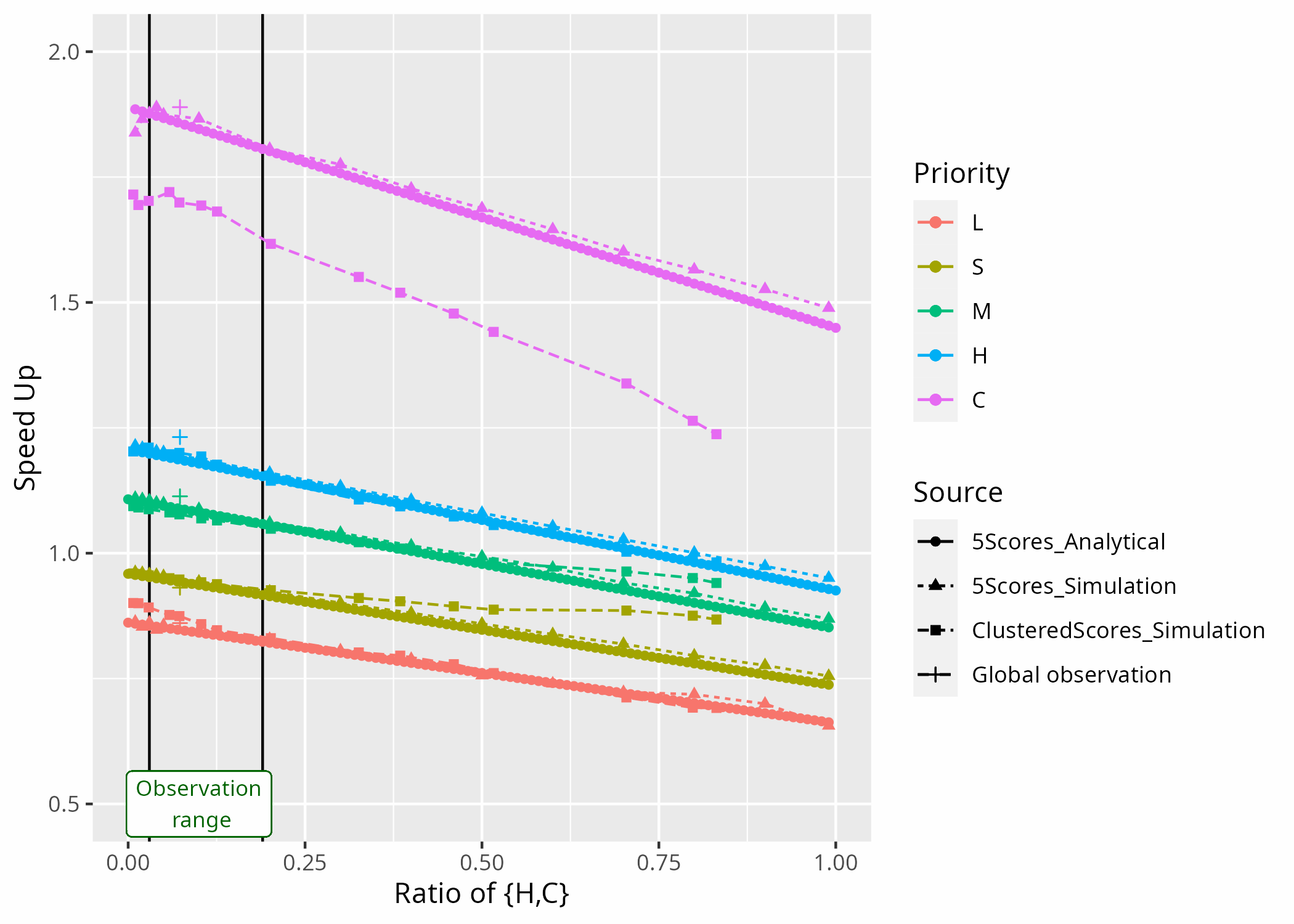
Within the operationally relevant range, increasing the share of Hot and Critical lots by one percentage point reduced the average class speed-up by approximately 0.0028. Increasing the high-priority share from 8% to 16%, for example, reduced the speed-up by approximately 0.0224.
These results highlight an important operational principle: priority does not create additional production capacity. It redistributes waiting time between different classes of lots. As more lots receive urgent status, prioritised lots lose part of their advantage, while standard lots may experience additional delays.
Supporting better priority decisions
The proposed approach can provide production managers with a practical decision-support tool for evaluating priority policies before applying them on the shop floor.
Different scenarios can be tested to estimate how a proposed proportion of urgent lots may affect production performance. The model can also help compare the formal priority hierarchy with the priority actually delivered by the manufacturing system and identify situations in which a priority category has become too broad to remain effective.
The research also shows that priority decisions should not be considered independently of product characteristics and manufacturing routes. A clustered version of the model that incorporated product and operation characteristics was more stable across two consecutive production periods than a model based on priority classes alone.
This type of transparency can support more informed discussions between manufacturing, planning, sales and customer-service teams. Requests for expedited production often originate outside the fab, while their operational consequences are experienced directly within production queues. A shared, data-driven scenario model can make these trade-offs visible before new commitments are made.
Looking ahead
The current study focuses on one workcentre and estimates average effects by priority class. Future work will extend the approach to additional workcentres and incorporate dynamic production information such as accumulated waiting time, due-date slack, equipment state and remaining route length.
Connecting workcentre-level estimates across the complete wafer route could also support broader cycle-time and completion-time forecasting at fab level.
The results demonstrate that effective priority management depends not only on identifying urgent production needs, but also on maintaining a balanced and selective priority policy. By learning directly from real dispatching decisions, data-driven models can support semiconductor manufacturers in balancing urgency, production efficiency and delivery performance.