September 01 2026
From Lots in Progress to Weekly Fab Output
Forecasting semiconductor production using remaining cycle time predictions
Adrien Wartelle, Stéphane Dauzère-Pérès, Claude Yugma, Quentin Christ and Renaud Roussel
Why fab output is difficult to forecast
Semiconductor supply chains depend on reliable information about what a wafer fab will complete in the coming weeks. Sales teams need realistic delivery commitments, planners need expected product volumes, and downstream facilities need to prepare capacity. Yet forecasting fab output remains challenging. A wafer lot may require hundreds of operations and several weeks or months to complete while competing with many other products for specialised equipment.
The challenge is particularly demanding in high-mix, low-volume production. Product priorities change, congestion shifts from one workcentre to another, and scheduling decisions continuously reshape lot progress. A useful forecast therefore needs to do more than extrapolate historical weekly output. It must take into account the position and likely progress of the lots that are already inside the fab.
Starting from lots already in production
The proposed approach forecasts fab output by predicting the remaining cycle time of each lot present at the forecasting date. Remaining cycle time is the estimated duration between the current position of a lot and its departure from the fab. Once this duration is predicted, the model assigns the lot to an expected completion week. Aggregating these predicted departures by week and product produces the output forecast.
This lot-level perspective is particularly relevant for medium-term planning because a large proportion of the lots that will leave the fab during the next quarter are already in production. It also provides more detailed information than a single aggregate forecast: planners can identify which lots are expected to complete, when they may leave, and how their predicted departures contribute to weekly product volumes.
Testing 26 statistical models
The study uses production data from 2023 and 2024 from a major STMicroelectronics wafer fab in Crolles, France. The analysis focuses on the 20 highest-volume products, representing more than 60% of production during the period. Three consecutive two-month testing windows were associated with three six-month training windows.
A total of 26 Gaussian linear regression models were evaluated. Their inputs combined information such as the number of remaining processing steps, the current route step, global work in process, and the mean priority recently assigned to the lot. Three output formulations were compared. The most effective formulation sorted remaining cycle times and associated them with lots according to their position in the production route.
How accurate were the forecasts?
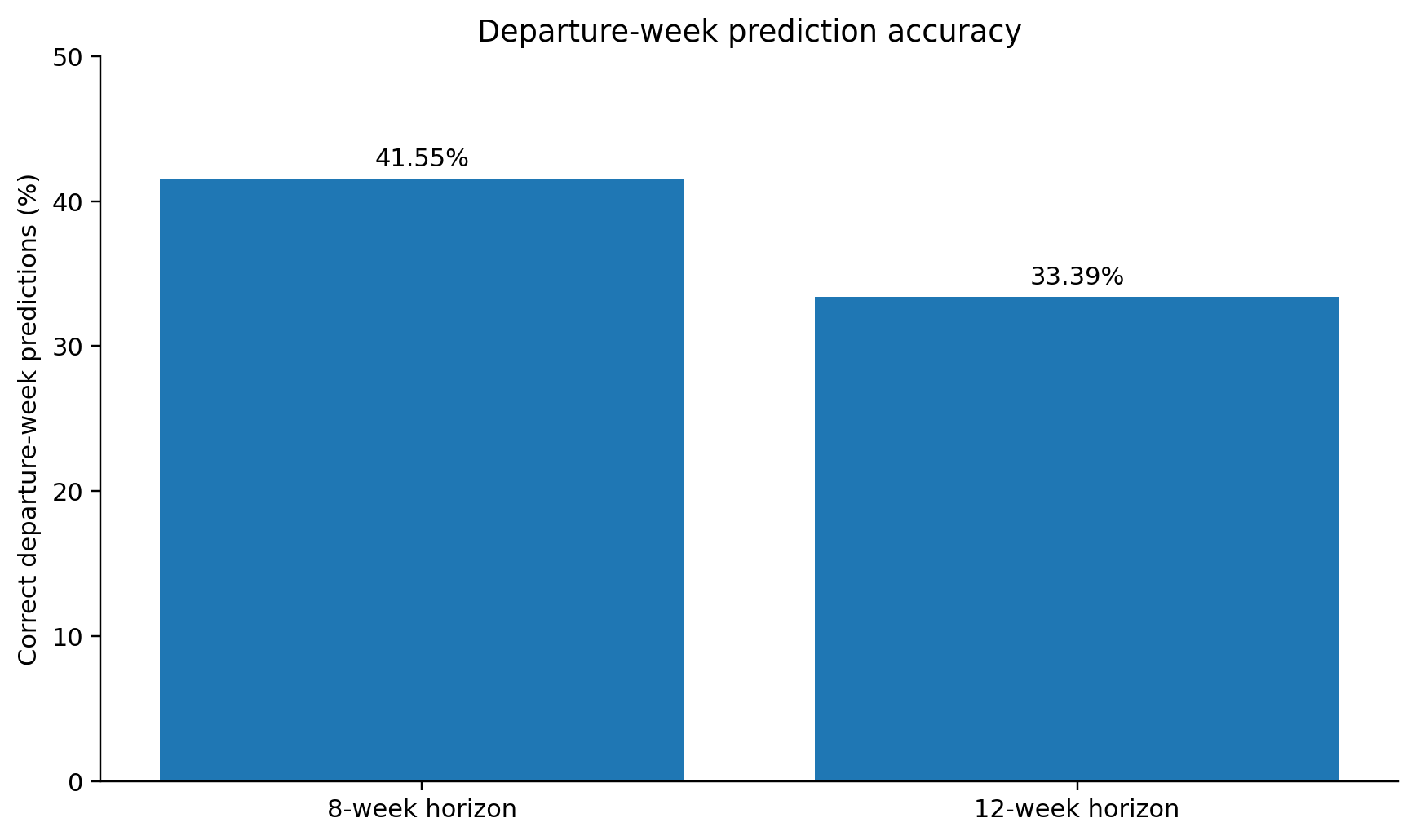
The best model predicted the correct departure week for 41.55% of lots over an eight-week horizon and 33.39% over a twelve-week horizon. Accuracy naturally decreased as the forecast horizon increased, as uncertainty accumulates, priorities change, and new production conditions emerge. For the twelve-week horizon, the best model achieved a mean absolute remaining-cycle-time error of 13.06 days on the testing data.
The partial forecast based on lots already present in the fab covered more than 90% of actual departures through week eight. Coverage then declined toward 60% by week twelve. This result helps identify where additional models become necessary. Forecasting weeks nine to twelve requires better estimates of future lot arrivals and of the full cycle times of lots that have not yet entered the fab.
A result that also reveals a limitation
The strongest model achieved 50.24% accuracy on training data but only 33.39% on testing data at twelve weeks, a gap of 16.8 percentage points. This difference illustrates how difficult it is to transfer patterns learned during one period to another. Product prioritisation and congestion vary over several months, altering the relationship between a lot's current position and its remaining time.
Variables such as global work in process and recent priority showed coherent effects within the training period, but they did not improve future forecasting performance. Aggregate indicators were unable to describe where congestion would affect each product route. More localised information is therefore needed, including waiting times at the remaining workcentres, equipment-specific congestion, current due dates, and changes in dispatching policies.
Toward a digital twin for output forecasting
The proposed framework provides an interpretable starting point for a wider forecasting system. Combined with forecasts of lot releases and full cycle times, it could support a digital twin that continuously estimates weekly fab output by product. Such a tool would connect shop-floor conditions with production planning and supply-chain commitments.
For planners, this means moving from a single volume estimate to a traceable forecast built from individual lots. When expected output changes, the model can indicate whether the cause is a delayed lot, a shift in priority, a congested route segment, or uncertainty about future releases. This traceability can improve coordination while keeping the limits of the forecast visible.
Looking ahead
Future work will investigate regression trees, artificial neural networks, and other nonlinear models. It will also incorporate due dates and more precise congestion information. The aim is not to produce a perfect long-range prediction, which is unrealistic in a highly variable fab, but to provide forecasts whose uncertainty is visible and whose accuracy can be monitored over time.
The results show that fab output forecasting can begin with the lots already in motion. Their route position, remaining operations, priority, and production environment contain valuable information about what the fab can deliver in the coming weeks.