November 15th 2026
Designing cross-tier semiconductor demand surveys
Before figures from chipmakers, Tier-1 suppliers and OEMs can be combined, each survey question has to carry the same meaning across all three tiers.
SC4EU’s WP5 has designed six survey instruments: a monthly operational survey and a yearly context survey for semiconductor manufacturers, Tier-1 suppliers and OEMs. The surveys cover current demand, expected future demand, inventory status and order cancellations. A full survey run across all six instruments has already been executed together with WP6 using multi-party computation. [1][4]
The difficult part starts before aggregation
A secure calculation does not fix an ambiguous question. If an OEM, a Tier-1 supplier and a semiconductor manufacturer interpret “demand” differently, the aggregate can be mathematically correct and still be operationally misleading.
Product scope is one obvious source of distortion. WSTS reported that, in the first half of 2026, memory sales were up 305% year on year while logic grew 45%. [2] A single “semiconductor demand” figure without a product or technology scope can therefore hide very different market conditions.
A push-out is not the same as a cancellation
Order changes provide a simple example. The Digital Reference defines an Order Reschedule as a change in the requested delivery date or volume of an order line. [3] If one respondent treats a push-out from March to June as a cancellation while another treats it as rescheduling, their answers cannot be combined cleanly.
The questionnaire has to decide the rule before the answer arrives: does “cancellation” mean a full withdrawal, a volume reduction, or any movement of demand? The ontology then gives that rule a stable semantic reference that can be reused across surveys and analytical tools.
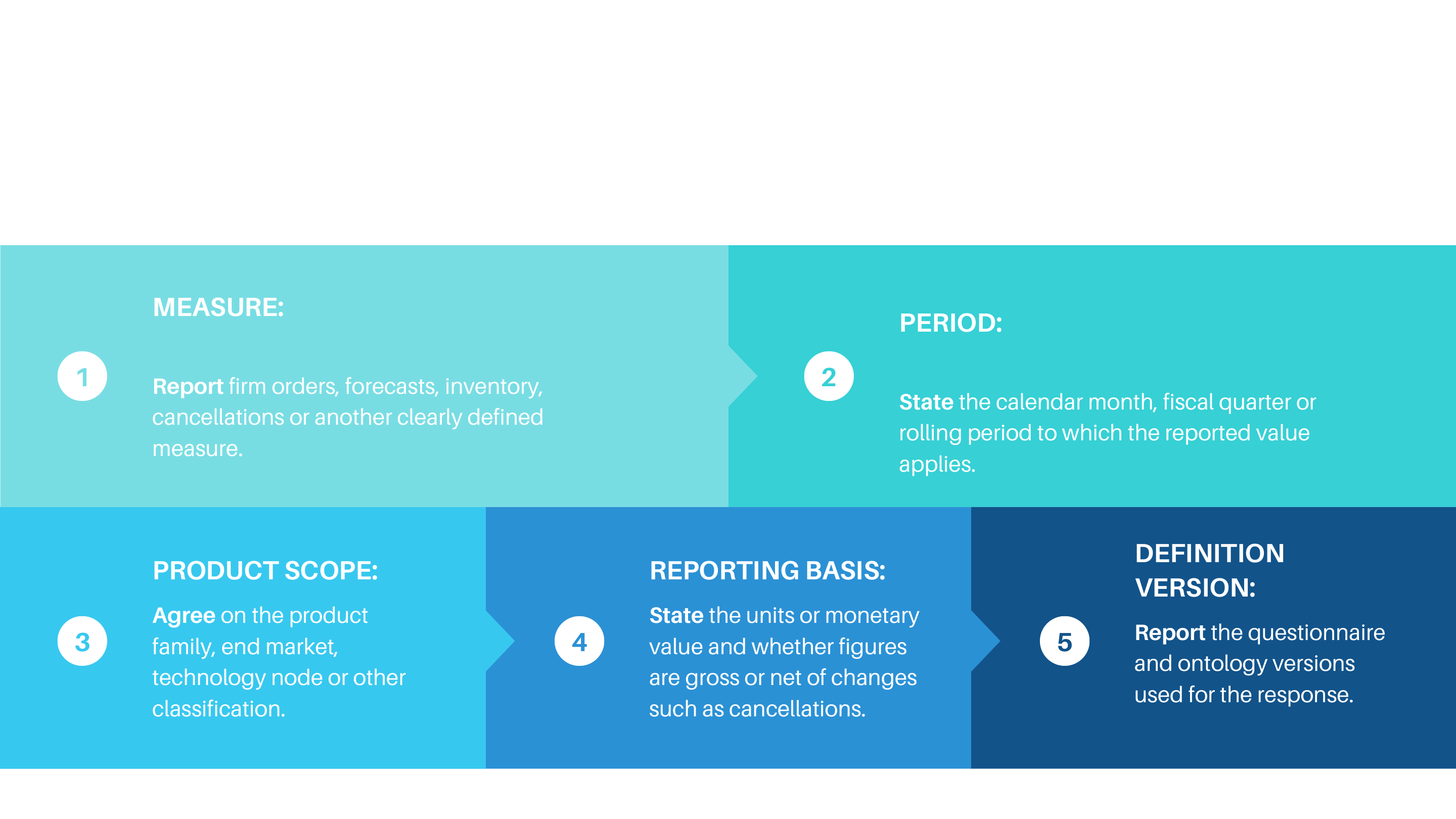
Five checks for a comparable survey field
For a cross-tier survey, five points need to be explicit before answers are combined:
Ontology-backed surveys reduce cross-tier translation work
WP5 has developed a Survey Ontology and connected it with the True Demand Knowledge Graph. [1] This gives the survey structure a semantic layer that can link questions to defined concepts rather than leaving each company to interpret spreadsheet headings independently.
The same principle supports recurring reporting. WP5 introduced a locally stored Excel-based input transformation tool that can pre-fill and carry forward previous answers while preserving anonymity within the MPC workflow. [1] The tool reduces repeated manual entry. When a value is reused across questionnaire or ontology versions, the relevant definition should be checked before submission.
Why this matters for forecasting
Forecasting cannot compensate for a survey in which respondents use different definitions for the same field. WP5 therefore links question design, ontology mapping and recurring data collection before the aggregated signal reaches forecasting.
That sequence gives the forecasting work a clearer input: comparable data whose meaning is defined before aggregation.
Sources
1. SC4EU: Work Package 5 - Survey Use Case & Demand Forecasting — 25 May 2026 — https://www.sc4.eu/index.php/news-events?catid=8%3Anews&id=90%3Asc4eu-press-release-exploitation-workshop-5&view=article
2. WSTS: Global Semiconductor Market records exceptional growth in Q2 2026 — Q2 2026 results — https://www.wsts.org/76/Global-Semiconductor-Market-records-exceptional-growth-in-Q2-2026
3. TIB: Digital Reference ontology repository — https://github.com/tibonto/dr
4. SC4EU: Work Package 6 - Anonymous Survey & Multi-Party Computation — 25 May 2026 — https://sc4.eu/index.php/news-events/news?catid=8%3Anews&id=89%3Asc4eu-press-release-exploitation-workshop-4&view=article
5. CORDIS: SC4EU project record — https://cordis.europa.eu/project/id/101139949