Governing confidential demand data in SC4EU
SC4EU combines cross-tier demand surveys, controlled access and multi-party computation so useful signals can be aggregated without turning company-level inputs into shared data.
SC4EU asks semiconductor manufacturers, Tier-1 suppliers and OEMs to contribute information on current demand, expected demand, inventory and order cancellations. Those data points are commercially sensitive. Participation depends on a simple question: what can each party see, and at which stage? [1]
EU policy already treats supply-chain data as sensitive
The European Chips Act recognises that semiconductor supply-chain information can be sensitive. During an activated crisis stage, Article 25 allows the European Commission to request information on production capabilities, production capacities and current primary disruptions. Article 32 requires confidential treatment of information obtained under the Regulation and protects sensitive business information and trade secrets. [2]
The Commission’s Chips Act 2.0 proposal, published in June 2026, adds a more proactive instrument: a Business-to-Business Semiconductor Supply Chain Platform intended to help industry improve resilience to supply disruptions. [3] Any voluntary data-sharing platform therefore needs rules that companies can understand before they contribute commercially sensitive information.
Four separate governance decisions
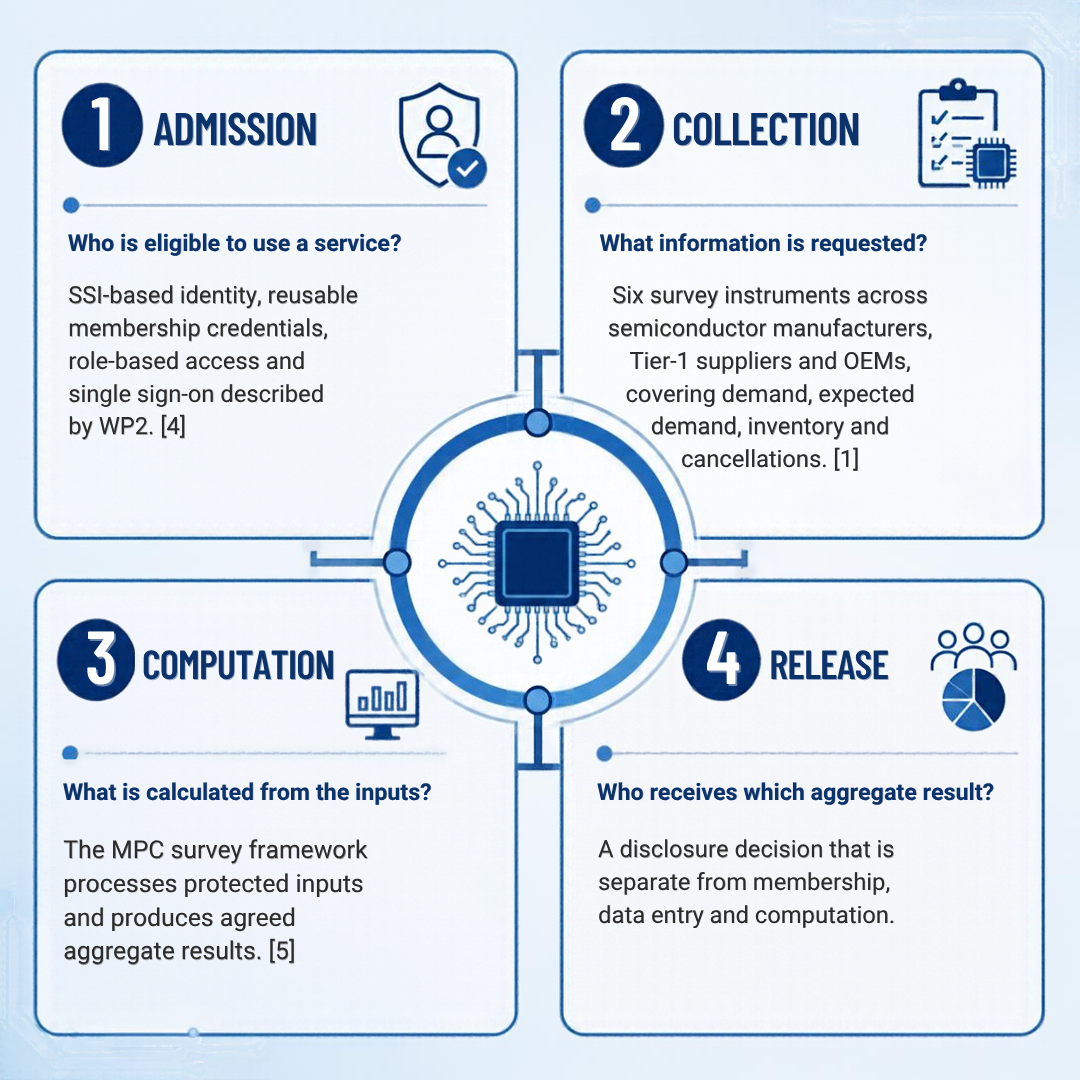
SC4EU’s public project updates describe several layers of that governance. They are easier to understand when separated into four decisions:
Identity and access are different questions
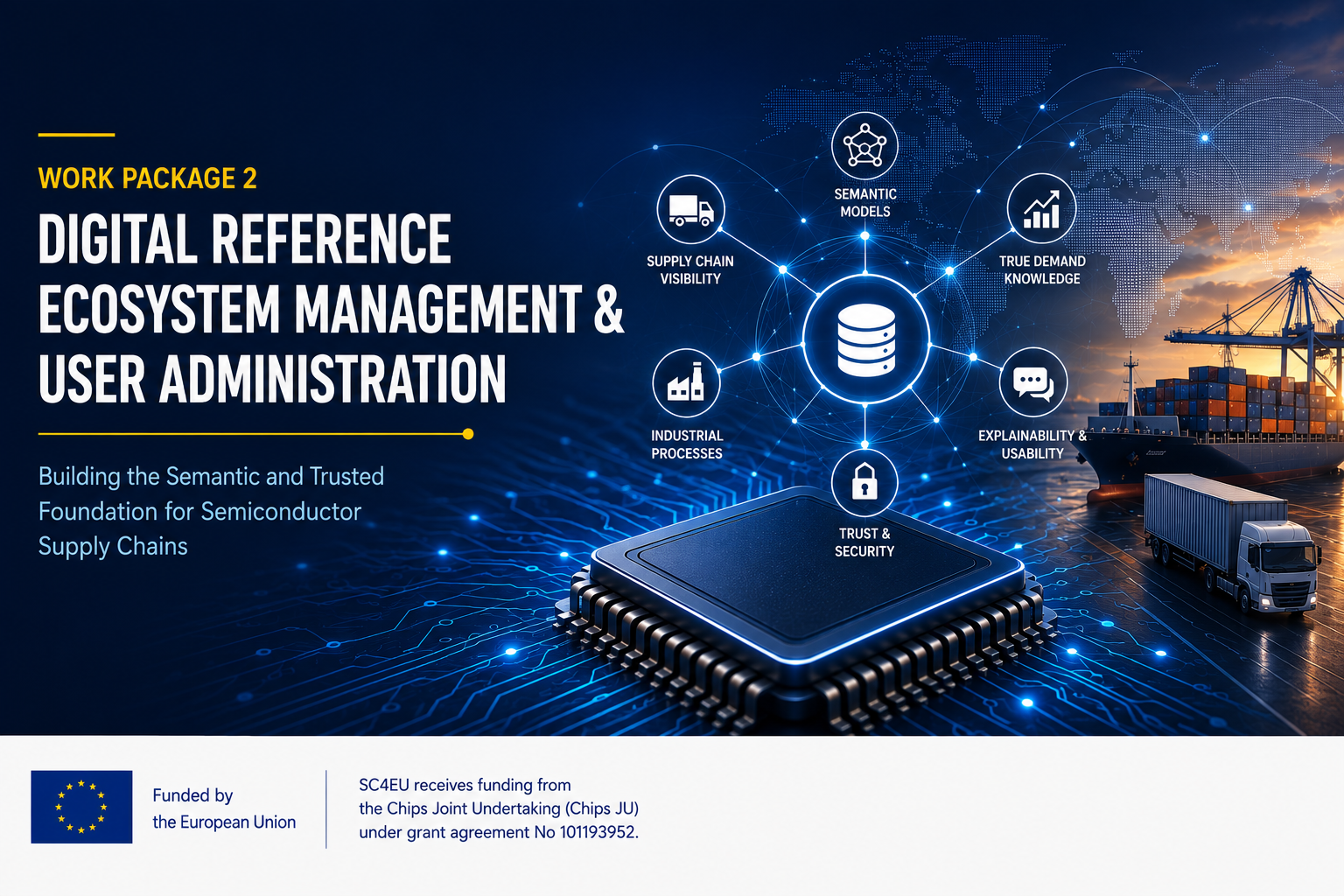
WP2 reports an SSI-based identity provider developed with SAP for onboarding, role-based access control and single sign-on across connected SC4EU applications. It also describes reusable membership credentials and voucher-based anonymous survey submission. [4]
A valid credential establishes that a participant is recognised by the platform. It does not, by itself, decide which survey outputs that participant may receive. Keeping eligibility and disclosure separate avoids a common governance mistake: treating “authorised user” as “authorised to see everything”.
The computation is designed around protected inputs
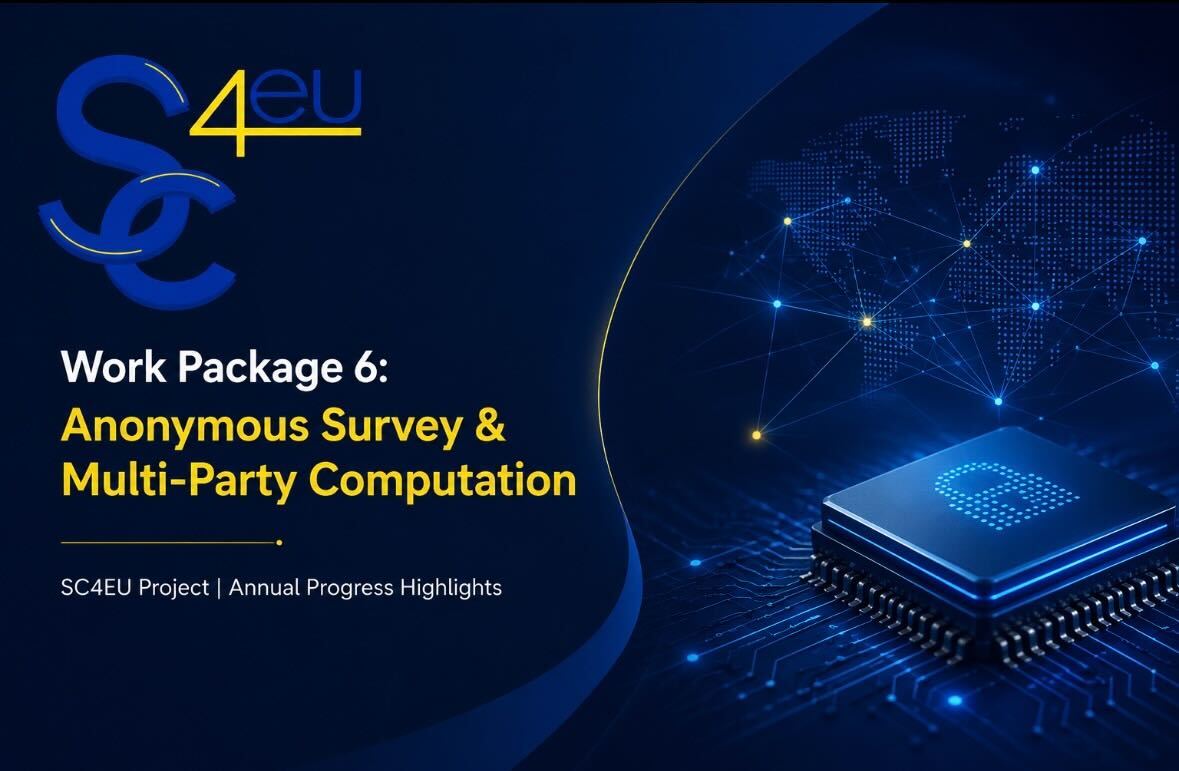
WP6 describes a multi-party computation framework in which participant inputs are split into cryptographic shares before transmission. Only normalised trend data, rather than absolute commercial figures, are uploaded to the platform. The project also reports a large-scale internal test with more than 20 participants and a full survey run across the six WP5 instruments. [5]
That architecture matters because the value of the survey is the aggregate signal, not a collection of company-level order books. A company should be able to contribute to a shared view of demand without making its individual commercial position the product of the exercise.
Open methods do not require open company data
A publicly funded project can explain its survey design, definitions, security architecture and analytical methods without publishing confidential participant inputs. This distinction is especially important for semiconductor demand data, where commercial sensitivity is high and the usefulness of the result depends on participation across several tiers of the value chain.
For industry users, the rules need to be operational: what is requested, how it is protected, what is computed and which result is returned. The technical controls and the communication around them must match.
The practical test
A membership credential answers an eligibility question. The survey defines what is collected. MPC defines how protected inputs are combined. A release rule defines who may receive the aggregate result. Keeping those decisions separate is what makes a cross-company demand platform credible.
Sources
1. SC4EU: Work Package 5 - Survey Use Case & Demand Forecasting — 25 May 2026 — https://www.sc4.eu/index.php/news-events?catid=8%3Anews&id=90%3Asc4eu-press-release-exploitation-workshop-5&view=article
2. Regulation (EU) 2023/1781 (European Chips Act), Articles 25 and 32 — https://eur-lex.europa.eu/eli/reg/2023/1781/oj/eng
3. European Commission: Chips Act 2.0 — updated 3 June 2026 — https://digital-strategy.ec.europa.eu/en/policies/chips-act-2
4. SC4EU: Building the Smart Backbone of Europe's Semiconductor Supply Chains — 24 July 2026 — https://sc4.eu/index.php/news-events/news?catid=8%3Anews&id=93%3Abuilding-the-smart-backbone-of-europes-semiconductor-supply-chains&view=article
5. SC4EU: Work Package 6 - Anonymous Survey & Multi-Party Computation — 25 May 2026 — https://sc4.eu/index.php/news-events/news?catid=8%3Anews&id=89%3Asc4eu-press-release-exploitation-workshop-4&view=article
6. CORDIS: SC4EU project record — https://cordis.europa.eu/project/id/101139949